
Table of Contents
- What Are Construction Loan Requirements for Small Developers?
- Credit Score and Financial Standing Requirements
- Debt-to-Income Ratio and Loan-to-Value Limits
- Builder Experience and Track Record Expectations
- Construction Loan Documents Checklist
- Hard Money Construction Loans for Challenging Borrowers
- SBA 504 Construction Loan Eligibility and Structure
- Construction Loan Down Payment and Equity Requirements
Construction Loan Requirements for Small Developers
Last Updated: July 26, 2026
What Are Construction Loan Requirements for Small Developers?
Understanding construction loan requirements for small developers is essential before approaching lenders. Most small developers underestimate the complexity of the application process, which explains why many deals stall before closing. At Asset Point Capital, we’ve reviewed hundreds of construction loan applications, and the difference between approval and rejection often comes down to how well a developer prepares their financial documentation and demonstrates their track record.
Construction loans differ fundamentally from traditional mortgages. Lenders finance a project in progress, not a completed property, which means they’re evaluating your ability to execute. The stakes are higher because construction projects carry inherent risk: delays, cost overruns, weather, permitting issues, and market shifts can all derail a deal.
The construction loan requirements for small developers typically include proof of creditworthiness, adequate equity in the project, relevant building experience, detailed project budgets, and a clear path to permanent financing. Below, we’ll walk through each requirement and show you how to strengthen your application.
Credit Score and Financial Standing Requirements
Your credit score matters, but it’s not the only measure of creditworthiness. Most traditional construction lenders require a minimum credit score between 680 and 720, depending on the lender and loan type. However, this threshold isn’t absolute. Hard money lenders and alternative financing sources typically have more flexible credit requirements, working with scores as low as 600, though rates and terms will reflect the added risk.
Lenders assess your financial standing through several metrics:
- Tangible net worth: Your total assets minus liabilities, excluding intangible assets. Most construction lenders want tangible net worth equal to at least 20-30% of the loan amount. For a $1 million construction loan, that means roughly $200,000-$300,000 in tangible assets.
- Liquidity: Lenders want proof of cash reserves to cover unexpected costs during construction. Aim for at least 10% of the total project budget in liquid reserves.
- Payment history: Recent late payments, collections, or tax liens are red flags. Fresh payment history strengthens your application.
If your credit score is below 680, focus on demonstrating strong liquidity and tangible net worth. Some lenders will overlook a mediocre score if you have substantial cash reserves and a solid track record of completed projects.
Debt-to-Income Ratio and Loan-to-Value Limits
Your debt-to-income (DTI) ratio tells lenders how much of your monthly income is committed to debt payments. Most construction lenders want to see a DTI ratio below 45%, though some will go as high as 50% for strong applicants. Calculate this by dividing your total monthly debt payments by your gross monthly income.
Many small developers forget to include the construction loan payment itself in the DTI calculation. Lenders use a projected payment based on the loan amount and estimated interest rate, even though you won’t make payments during the construction phase.
Loan-to-value (LTV) and loan-to-cost (LTC) ratios determine how much of the project the lender will finance versus how much equity you need to contribute.
- LTV (Loan-to-Value): The loan amount divided by the finished property value. Most lenders cap LTV at 75-80%. If your project will be worth $2 million when complete and the lender offers 75% LTV, you can borrow up to $1.5 million but need $500,000 in equity.
- LTC (Loan-to-Cost): The loan amount divided by the total project cost (land + construction + soft costs). LTC limits typically range from 85-90% for experienced developers. If your total project cost is $1.2 million and the lender offers 85% LTC, you can borrow $1.02 million and need $180,000 in equity.
Don’t confuse LTC and LTV, they measure different things. A lender might offer 85% LTC but only 75% LTV. You must meet BOTH thresholds, not just one.
Builder Experience and Track Record Expectations
Most construction lenders want to see proof that you’ve successfully completed similar projects. For a small developer seeking their first construction loan, lenders typically want one of the following:
- Completed projects: Evidence that you’ve finished at least one residential or commercial construction project of comparable size and complexity, with permits, completion certificates, and photos.
- Industry experience: Years of experience as a general contractor, project manager, or architect serve as a proxy for execution capability.
- Co-developer or partner: Pairing with an experienced builder or developer who has a track record strengthens your application.
- Bonding and insurance: Securing a performance bond and comprehensive general liability insurance signals seriousness to lenders.
Lenders will verify that past projects were completed on time and within budget. A history of cost overruns or delays will hurt your application. What matters most is demonstrating competence and reliability through whatever evidence you can provide.
Construction Loan Documents Checklist
The documentation phase is where many applications fail, not because the developer doesn’t qualify, but because financial records aren’t properly organized. Lenders need a complete picture of your finances and project details.
Personal Financial Documents
- Personal tax returns (last 2 years)
- Bank statements (last 60-90 days) to verify liquidity
- Credit report authorization
- Personal financial statement listing assets and liabilities
- Proof of significant assets (real estate, investments, retirement accounts)
Business Financial Documents
- Business tax returns (last 2 years) if applicable
- Profit and loss statements (last 2 years)
- Balance sheets
- Business bank statements (last 60-90 days)
Project-Specific Documents
- Detailed project budget (hard costs + soft costs breakdown)
- Construction timeline and draw schedule
- Architectural plans and specifications
- Proof of land ownership or purchase agreement
- Property appraisal or preliminary valuation
- Proof of permits or evidence that permits are in process
- Insurance quotes or proof of coverage
Experience and Track Record Documents
- Resume highlighting construction and development experience
- References from past clients, contractors, and previous lenders
- Photos or documentation of completed projects
- Proof of relevant licenses or certifications
- Documentation of partnerships or co-developer arrangements if applicable
Missing documents don’t kill a deal, but incomplete or outdated documents do. Verify that every tax return is current, every bank statement is recent, and every project plan is detailed enough to answer lender questions without follow-up.
The most common mistake is submitting generic budgets or outdated financial statements. Lenders want line-item detail in your project budget, not round number estimates. They want recent bank statements and detailed project plans that signal you’ve done your homework.
Hard Money Construction Loans for Challenging Borrowers
Hard money construction loans exist for developers who don’t fit the traditional mold. If your credit score is below 680, your DTI is above 50%, or you’re a first-time developer with limited experience, hard money might be your path forward.
Hard money lenders focus less on credit scores and more on the deal itself. They evaluate the project’s fundamentals: Is the property worth more than the loan amount? Can you execute the construction? Is there a clear exit strategy?
The trade-off is cost. Hard money loans typically carry higher interest rates and fees than traditional construction loans. However, they close faster, often in 2-3 weeks, and involve less documentation. For developers in a time crunch or facing credit challenges, the speed and flexibility can outweigh the higher cost.
Hard money lenders still require proof of liquidity (10-15% of project cost in cash reserves), a detailed project plan and budget, evidence of your ability to execute, an appraisal of the finished property, and a clear exit strategy.
SBA 504 Construction Loan Eligibility and Structure
The SBA 504 program is designed for small businesses and entrepreneurs. While not exclusively a construction loan program, it can finance real estate and equipment for eligible businesses.
To be eligible for an SBA 504 loan, your business must meet these criteria:
- Size requirement: You must be a small business under SBA size standards, typically fewer than 500 employees.
- For-profit status: Your business must be organized for profit.
- Personal investment: You must have invested at least 20% of the project cost in equity.
- Use of proceeds: The loan must finance real estate, equipment, or both for business use. Speculative construction typically doesn’t qualify; the property must be used by your business.
- Creditworthiness: You must be creditworthy, though the bar is lower than traditional construction loans. Many lenders will work with scores above 640.
The SBA 504 structure is a two-lien program: a conventional lender provides up to 50% of project cost, an SBA-certified development company provides up to 40%, and you contribute at least 10%. This allows you to finance up to 90% of the project cost with SBA backing. The disadvantage is that the process is slower than traditional construction loans, typically 60-90 days, because it involves two lenders and SBA approval.
SBA 504 loans are best suited for developers who plan to occupy the property themselves and who have limited down payment capital. They’re less suitable for spec developers building to sell.
Construction Loan Down Payment and Equity Requirements
The amount of equity you need to contribute depends on the lender and loan type:
- Traditional construction lenders: 15-25% equity requirement (75-85% LTC)
- Hard money lenders: 10-15% equity requirement (85-90% LTC)
- SBA 504 lenders: 10% equity requirement (90% LTC)
- Bank construction loans: 20-30% equity requirement (70-80% LTC)
Your equity can take several forms: cash, real estate you already own, or a combination. Some lenders will count land value as part of your equity if you own the land outright. Others require cash or liquid assets only.
For example: You’re building a $1 million project. A traditional lender offers 85% LTC, meaning they’ll lend $850,000. You need to contribute $150,000 in equity. If you own the land worth $100,000, the lender might count that toward your equity, requiring $50,000 in cash.
The equity requirement protects the lender. If you have significant skin in the game, you’re less likely to walk away if costs rise or the market shifts.
If you’re short on cash equity, explore whether the lender will allow land value or other real estate to count. Ask upfront to avoid surprises during underwriting.
How to Strengthen Your Construction Loan Application
Most construction loan rejections aren’t because developers don’t qualify, but because applications are incomplete, outdated, or poorly organized. Here’s how to strengthen yours:
1. Organize your financials ruthlessly. Create a single folder with all tax returns, bank statements, and financial statements, clearly labeled by year. Making your application easy to review gets you faster decisions.
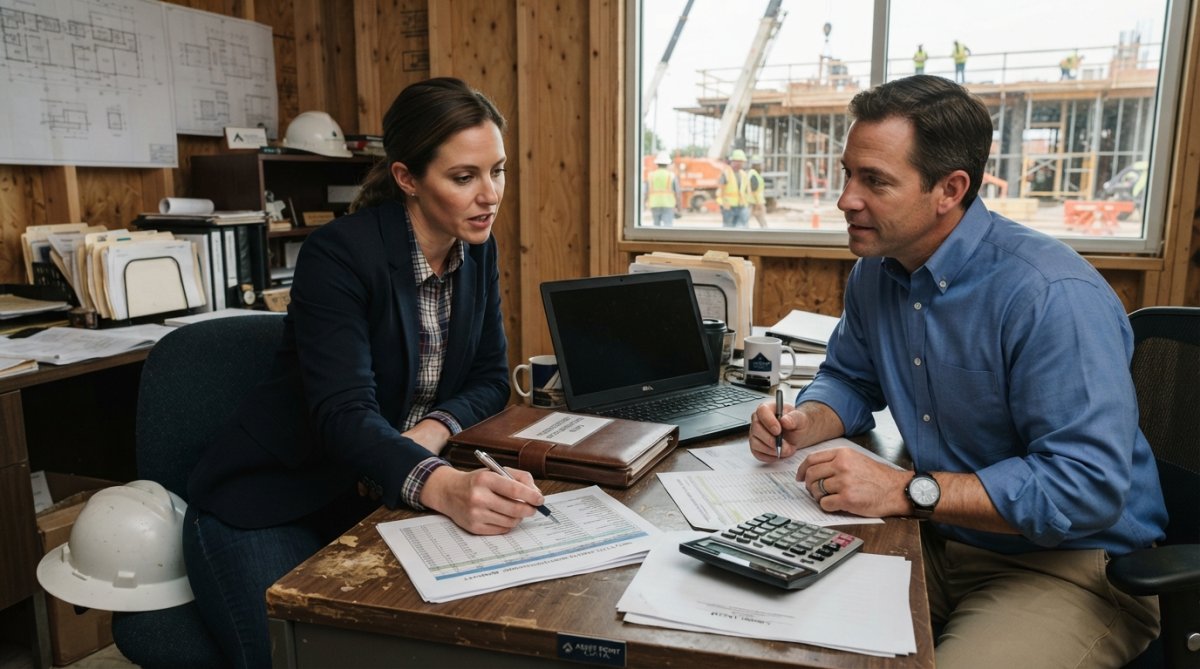
2. Build a detailed project budget. Break down every cost: land acquisition, hard costs (materials, labor, equipment), soft costs (permits, insurance, architecture, financing), and contingency (typically 5-10%). Show where each number comes from.
3. Demonstrate liquidity. Highlight healthy personal bank balances. If you’re using investor capital, provide proof of those funds or a commitment letter.
4. Get pre-approved for permanent financing. Construction loans are temporary. A pre-approval letter from a permanent lender strengthens your construction loan application by proving you have an exit strategy.
5. Secure your permits or show clear progress. If you haven’t obtained permits yet, show evidence of submitted applications, meetings with the municipality, or preliminary approvals. Permits are a common deal-killer; showing you’re on top of this removes a major risk factor.
6. Provide strong references. Get written references from past clients, contractors, and previous lenders. Phone references are better because lenders can ask follow-up questions.
7. Partner with an experienced developer if you’re new. Bringing on a partner with a track record can unlock lenders who would otherwise pass.
Construction loan requirements for small developers are stringent, but they’re designed to protect both lender and borrower. The developers who succeed understand what lenders care about: execution capability, financial stability, and clear exit strategies. If your application doesn’t meet traditional lender requirements, hard money and SBA 504 programs offer alternative paths. The key is starting early, organizing your documentation, and being honest about your experience and finances. When you’re ready to explore your options, Asset Point Capital provides firm term sheets within 24 hours and can fund construction projects in as little as 2-3 weeks, combining direct lending capacity with access to over 1,025 niche market options to match you with the right program for your deal.
Frequently Asked Questions
What credit score is needed for a construction loan for small developers?
Most traditional construction lenders require a minimum credit score of 680-720, though some programs accept scores as low as 640. Hard money construction loans and alternative lenders may work with lower scores. Your credit history, recent delinquencies, and overall financial profile matter as much as the score itself. Before applying, review your credit report for errors and address any recent payment issues.
What financial documents are required for a small developer construction loan?
Standard construction loan documents checklist includes: two years of personal and business tax returns, bank statements (typically 60 days), proof of liquidity and tangible net worth, a detailed project budget, architectural plans and permits, a construction timeline with draw schedule, proof of builder experience or contractor licensing, and personal financial statements. Lenders verify these documents during underwriting to assess your ability to complete the project and repay the loan.
How much down payment do I need for a construction loan?
Construction loan down payment requirements typically range from 10-25% of the total project cost, depending on your experience, credit profile, and the lender. Some programs offer up to 80% loan-to-value (LTV) or 90% loan-to-cost (LTC) ratios for qualified borrowers, reducing your required equity. First-time developers often face higher down payment requirements until they demonstrate successful project completion.
Are hard money construction loans a viable option if I have credit challenges?
Yes. Hard money construction loans are designed for borrowers who don't qualify for traditional bank financing due to credit issues, limited experience, or non-standard projects. These loans prioritize the property's value and project feasibility over credit score. Interest rates and fees are higher than traditional construction loans, but approval is faster and documentation requirements are less stringent. Hard money works well for fix-and-flip projects and short-term construction needs.
What is the difference between SBA 504 construction loan eligibility and traditional construction financing?
SBA 504 loans are government-backed programs for small businesses and require a small business owner to occupy or operate the property. They offer longer repayment terms and lower rates than traditional construction loans, but have stricter eligibility rules and slower processing. Traditional construction loans are faster, more flexible on project types, and don't require owner-occupancy. Choose SBA 504 if you meet eligibility criteria and can wait for approval; use traditional financing for speed and flexibility.
How do I transition from a construction loan to permanent financing?
Construction-to-permanent financing (also called a construction-perm loan) rolls your construction loan into a long-term mortgage after project completion. This simplifies the process and locks in permanent rates early. During the construction phase, you pay interest-only on drawn funds. Once construction finishes and the property is appraised, the loan converts to a standard amortizing mortgage. This structure is ideal for developers who want certainty and avoid the hassle of refinancing separately.
What tax implications should small developers consider with construction loans?
Interest paid on construction loans is generally tax-deductible as a business expense. However, the timing of deductions depends on whether you're capitalizing costs into the asset or expensing them. Soft costs (fees, permits, insurance) and hard costs (materials, labor) have different tax treatment. Consult a tax professional to understand capitalization rules and depreciation schedules for your specific project. Proper documentation from your draw schedule and lender statements is essential for tax reporting.
External Sources Referenced
[EXTERNAL_LINK: SBA 504 Loan Program Requirements and Eligibility | sba.gov]
[EXTERNAL_LINK: Federal Reserve Guidelines on Construction Lending Standards | federalreserve.gov]
[EXTERNAL_LINK: National Association of Home Builders Construction Finance Best Practices | nahb.org]
This article was written using GrandRanker