
Table of Contents
- Commercial Real Estate Loan Closing Timeline: What to Expect
- The 7 Key Stages of Commercial Loan Closing
- Stage 1: Letter of Intent and Purchase Agreement
- Stage 2: Loan Application and Initial Underwriting
- Stage 3: Due Diligence and Property Appraisal
- Stage 4: Formal Loan Approval and Commitment
- Stage 5: Title Search, Survey, and Legal Review
- Stage 6: Final Closing Documents and Escrow
- Stage 7: Funding and Recording
- Commercial Loan Due Diligence: The Timeline Accelerator
- SBA Loan Closing Timeline vs. Conventional and Bridge Loans
- Critical Commercial Real Estate Loan Documents Checklist
- Factors That Accelerate or Delay Commercial Real Estate Loan Closing
- Borrower Preparation Checklist: Beyond Standard Documents
- Real-World Closing Scenarios: What Actually Happens
Commercial Real Estate Loan Closing Timeline: 7 Key Stages
Last Updated: July 30, 2026
Understanding the commercial real estate loan closing timeline is essential for anyone acquiring investment property, development land, or income-generating assets. The closing process typically spans 30 to 90 days, depending on loan type, property complexity, and lender efficiency. At Asset Point Capital, we’ve helped real estate investors navigate this process with clarity and speed.
The difference between a smooth closing and a protracted nightmare often comes down to preparation. Most borrowers underestimate the due diligence phase and scramble when lenders request additional documentation.
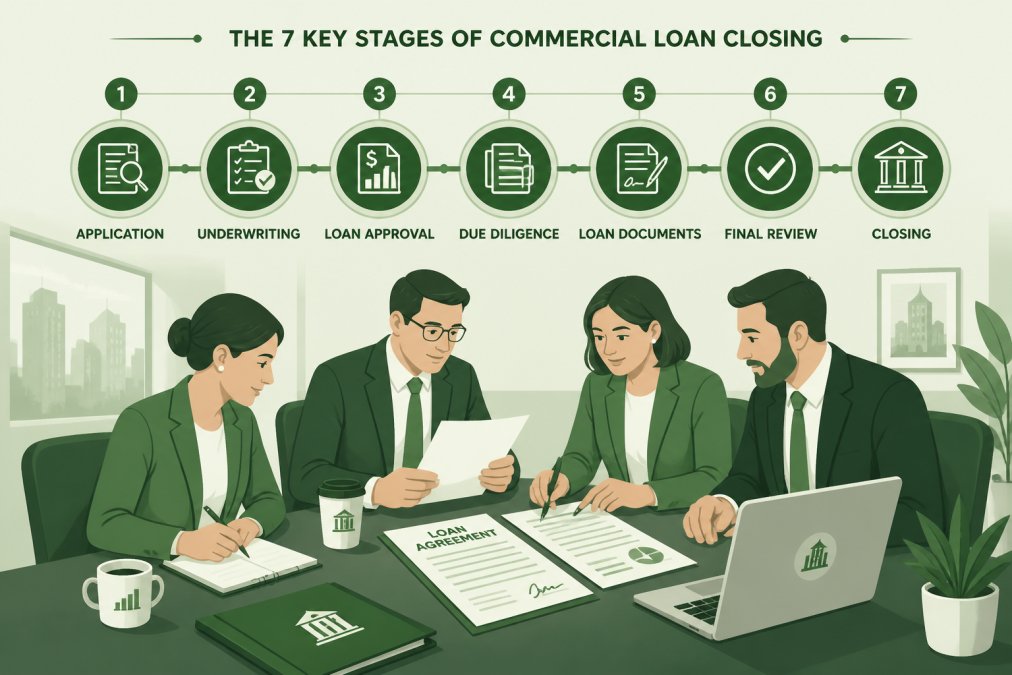
The 7 Key Stages of Commercial Loan Closing
The commercial real estate loan closing timeline follows a predictable sequence, though timelines vary significantly based on loan structure and market conditions.
Stage 1: Letter of Intent and Purchase Agreement
Your journey begins with a letter of intent (LOI), a non-binding document that outlines basic deal terms and signals serious intent to the seller. This stage typically takes 1-2 weeks.
Once the LOI is accepted, you’ll move to the purchase and sale agreement (PSA), which is legally binding and includes contingencies such as financing, inspections, and appraisals. Consult your lender before signing the PSA to ensure the closing timeline is realistic.
Stage 2: Loan Application and Initial Underwriting
Once the PSA is signed, you’ll submit a formal loan application with basic financial documentation: personal tax returns (usually 2 years), business financial statements, bank statements, and a detailed property description. This stage typically takes 3-7 days.
Initial underwriting is the lender’s preliminary review to confirm your deal is fundable before investing significant resources in due diligence. The lender also orders the appraisal at this stage, one of the longest-lead items in the entire process.
Stage 3: Due Diligence and Property Appraisal
Due diligence typically spans 14-30 days and involves multiple parallel workstreams: appraisal, environmental assessment, property inspections, rent roll verification, and lender’s legal review.
The appraisal is the most time-intensive component. Appraisers must physically inspect the property, research comparable sales, and analyze market conditions. For standard commercial properties, this takes 7-14 days. For complex properties, appraisals can stretch to 21+ days.
Environmental assessments (Phase I for all properties, Phase II if Phase I raises concerns) add another 7-14 days. Property inspections by structural engineers or other specialists may be required depending on property age and condition.
Order the appraisal and environmental assessment immediately after loan application approval. These are the longest-lead items. Proactively ordering them can save 1-2 weeks on your overall timeline.
Stage 4: Formal Loan Approval and Commitment
Once due diligence is substantially complete and underwriting has reviewed all documentation, the lender issues a formal loan commitment. This legal document outlines the exact loan terms, conditions, and contingencies that must be satisfied before funding.
The commitment letter typically includes conditions such as: final appraisal at or above purchase price, clear title with no liens, proof of hazard insurance, and updated financial statements. This stage usually takes 5-10 days from the time underwriting completes its review.
Stage 5: Title Search, Survey, and Legal Review
While due diligence is underway, the title company conducts a title search to ensure the seller has clear ownership and that no liens or encumbrances exist against the property. This typically takes 5-10 days.
A survey may be required depending on your lender’s guidelines and the property type. Surveys are essential for land purchases or development projects and take 10-21 days depending on property size and complexity.
The lender’s legal counsel reviews all documents and prepares closing documents: the promissory note, mortgage or deed of trust, and any loan-specific agreements. Legal review typically takes 7-14 days.
Stage 6: Final Closing Documents and Escrow
As you approach the closing date, the title company prepares the final closing statement, which details all credits, debits, and fund transfers. This stage typically takes 3-5 days and involves a final walkthrough of the property and a final title review to ensure no new liens have been recorded.
Escrow ensures all parties perform their obligations simultaneously. The title company holds funds and documents until all closing conditions are satisfied, then releases them simultaneously.
Stage 7: Funding and Recording
On the closing date, you sign all documents at the title company or attorney’s office. The lender wires funds to the escrow account. The title company then funds the seller, pays off any existing liens, and records the new mortgage or deed of trust with the county recorder. This stage typically takes 1-3 days from signing to full funding and recording.
The entire commercial real estate loan closing timeline, from LOI to funding, typically spans 30 to 90 days. SBA loans often take 60-90 days due to additional government review. Conventional loans and bridge loans can close in 30-45 days if due diligence is clean and underwriting moves quickly.
Commercial Loan Due Diligence: The Timeline Accelerator
Due diligence is the phase where most commercial real estate loan closing timelines extend or compress. Lenders conduct due diligence to verify that the property and your financial profile support the loan.
The key to accelerating due diligence is anticipation. Before you even apply for the loan, order a Phase I environmental assessment, arrange a professional property inspection, and compile all relevant documents. Proactive borrowers who provide documents before being asked close faster on average.
For multifamily, retail, or office properties, lenders will scrutinize lease agreements, tenant credit quality, and lease expiration dates. For development or construction financing, due diligence includes review of construction plans, contractor qualifications, building permits, and zoning compliance. This phase can extend 30-45 days because lenders must ensure the project is feasible and compliant before committing capital.
SBA Loan Closing Timeline vs. Conventional and Bridge Loans
Not all commercial loans close on the same timeline. The loan type significantly impacts how long the process takes.
SBA loans typically close in 60-90 days. SBA loans require additional government review and compliance documentation. The SBA guarantees a portion of the loan, which reduces the lender’s risk but comes with additional underwriting requirements and documentation that extend the timeline.
Conventional loans (bank loans without government backing) typically close in 30-45 days. Banks move faster because they’re not subject to government review, though they are more selective about which deals they’ll fund.
Bridge loans (short-term, asset-based loans) can close in 2-3 weeks. Bridge lenders focus on the property’s value and your exit strategy, not your personal credit. They move quickly because they’re accepting higher risk in exchange for higher interest rates and shorter terms.
Hard money loans (loans from private lenders) can close in 10-14 days. These are the fastest option but come with the highest costs.
| Loan Type | Typical Timeline | Key Advantage | Best For |
|---|---|---|---|
| SBA Loan | 60-90 days | Lower rates, longer terms | Established businesses, strong financials |
| Conventional Bank | 30-45 days | Competitive rates | Seasoned properties, strong borrowers |
| Bridge Loan | 14-30 days | Speed, asset-based | Time-sensitive acquisitions, fix-and-flip |
| Hard Money | 10-21 days | Fastest closing | Distressed properties, urgent situations |
Critical Commercial Real Estate Loan Documents Checklist
The commercial real estate loan closing process generates dozens of documents. Here’s what you need to prepare and understand before closing.
Borrower Financial Documents:
- Personal tax returns (typically 2 years)
- Business tax returns (if applicable, typically 2-3 years)
- Personal financial statements (current as of loan application date)
- Bank statements (typically 2-3 months recent)
- Proof of liquid reserves
- Explanation letters for any credit issues or employment gaps
Property Documents:
- Purchase and sale agreement (fully executed)
- Title commitment from title company
- Survey (if required by lender)
- Phase I environmental assessment
- Phase II environmental assessment (if Phase I raises concerns)
- Property inspection reports
- Appraisal report
- Rent roll (for income-producing properties)
- Lease agreements (all tenant leases)
- Property tax assessments and recent tax bills
- Proof of hazard insurance
Loan Documents:
- Promissory note
- Mortgage or deed of trust
- Loan commitment letter
- Closing statement
- Truth in Lending Act (TILA) disclosure
- Loan Estimate
- Any loan-specific agreements
Legal and Closing Documents:
- Closing disclosure
- Title insurance policy
- Proof of earnest money deposit
- Affidavits (occupancy, title, no liens)
- Recording documents
Request documents in advance, at least 5 business days before your scheduled closing date.
If you discover a discrepancy in closing documents the day before closing (e.g., loan amount is wrong, interest rate doesn’t match the commitment letter, or property description is inaccurate), you risk delaying closing by several days while documents are corrected and re-prepared. Always review documents early.
Factors That Accelerate or Delay Commercial Real Estate Loan Closing
The commercial real estate loan closing timeline is not fixed. Several factors can compress the process to 30 days or extend it to 120+ days.
Property Type and Market Conditions: Stabilized, income-producing properties close faster than development projects or distressed properties. In a rising market with strong demand, lenders move faster because they’re confident in property values.
Lender Type and Loan Structure: Portfolio lenders (banks that hold loans on their balance sheet) typically move faster than correspondent lenders. Larger lenders with more underwriting staff can process loans faster, though they may have more bureaucracy.
Asset Point Capital’s hybrid model, combining direct capital with access to 1,025+ niche market options, allows for faster closings because borrowers can match their deal to the right lender quickly.
Environmental and Zoning Contingencies: Environmental issues are the most common cause of delays. If a Phase I assessment identifies potential contamination, a Phase II investigation is required, which can take 3-4 weeks. Zoning issues also delay closings if your intended use requires a variance or conditional use permit.
Borrower Preparation Checklist: Beyond Standard Documents
Most guides list the documents you need for closing. Here’s what separates borrowers who close on time from those who experience delays.
Financial Preparation: Verify your credit score and address any recent negative items. Prepare explanation letters for any credit issues or employment gaps. Ensure your bank statements are clean and document the source of your down payment.
Property Preparation: Schedule property inspections early. Order the environmental assessment before loan application if possible. Gather all existing property documentation. If the property has tenants, prepare a detailed rent roll with lease copies.
Lender Communication: Designate a single point of contact for all lender communication. Respond to lender requests within 24 hours. Provide documents proactively. Confirm the closing date and location at least 10 business days before closing.
Title and Legal Preparation: Order a preliminary title report as early as possible. Review the title report carefully and address any liens or claims immediately. Have your attorney review the purchase agreement and loan documents before signing.
Insurance Preparation: Obtain a hazard insurance quote and commitment letter from your insurance agent before closing. Ensure the insurance policy names the lender as loss payee.
Create a closing timeline spreadsheet with all key dates: appraisal order date, due diligence deadline, commitment letter target date, title report delivery, survey completion, insurance commitment, document delivery, and closing date. Share this with your lender and title company.
Real-World Closing Scenarios: What Actually Happens
Scenario 1: Stabilized Apartment Complex, Conventional Loan
You’re buying a 24-unit apartment complex with strong cash flow using a conventional bank loan.
- Days 0-3: Loan application and initial underwriting. The lender orders appraisal and environmental assessment.
- Days 3-14: Appraisal and environmental assessment underway. You submit updated financial statements and proof of down payment funds.
- Days 14-21: Appraisal completed. Environmental assessment shows no issues. Lender begins formal underwriting.
- Days 21-28: Underwriting review complete. Lender issues commitment letter with standard contingencies.
- Days 28-35: Title company completes title search. Lender’s attorney reviews documents and prepares closing documents.
- Days 35-40: Final closing documents prepared and delivered for your review.
- Day 40: Closing. All documents signed, funds wired, mortgage recorded.
Total timeline: 40 days.
Scenario 2: Development Land with Zoning Questions, Bridge Loan
You’re buying raw land for a 50-unit development using a bridge loan to close quickly.
- Days 0-2: Loan application. Bridge lender orders appraisal and environmental assessment. You provide preliminary development plans.
- Days 2-7: Appraisal underway. You meet with local zoning department and discover that a conditional use permit is required.
- Days 7-14: Appraisal completed. Environmental assessment shows no issues. Lender issues conditional commitment requiring proof of zoning compliance.
- Days 14-35: You work with your attorney to file for the conditional use permit.
- Days 35-40: Zoning approval obtained. You submit approval to lender.
- Days 40-45: Lender issues final commitment. Title company completes title search. Closing documents prepared.
- Day 45: Closing.
Total timeline: 45 days.
Scenario 3: Secondary Market Property, SBA Loan, with Environmental Concerns
You’re buying a small office building using an SBA loan. The Phase I environmental assessment flags potential contamination from a former dry cleaner on the adjacent property.
- Days 0-5: Loan application. SBA lender orders appraisal, environmental assessment, and business plan review.
- Days 5-21: Appraisal underway. Phase I assessment completed, identifies potential contamination. Lender requires Phase II assessment.
- Days 21-35: Phase II assessment underway. Appraisal completed. Lender begins underwriting but flags environmental contingency.
- Days 35-49: Phase II assessment completed. Results show low-level contamination but no active remediation required.
- Days 49-60: Lender issues conditional commitment requiring environmental liability insurance. You obtain insurance commitment.
- Days 60-70: Title search completed. Lender’s attorney reviews all documents. SBA compliance review underway.
- Days 70-80: SBA compliance review complete. Final closing documents prepared.
- Day 80: Closing.
Total timeline: 80 days. The environmental contingency and SBA review extended the timeline significantly.
Accelerating Your Commercial Real Estate Loan Closing Timeline
If your timeline is tight, here are concrete steps to accelerate the process.
1. Choose the Right Lender: Not all lenders move at the same speed. Bridge lenders and hard money lenders close faster than banks and SBA lenders. Asset Point Capital’s hybrid model allows you to match your deal to the optimal lender within 24 hours, avoiding delays from shopping multiple lenders.
2. Pre-Order Due Diligence Items: Don’t wait for the lender to request appraisals, environmental assessments, and inspections. Order them immediately. This can save 1-2 weeks on your overall timeline.
3. Provide Documents Proactively: Respond to lender requests within 24 hours. Better yet, provide documents before being asked. Proactive borrowers close faster than reactive ones.
4. Engage Your Attorney Early: Have your attorney review the purchase agreement and loan documents before signing. This prevents delays caused by legal issues discovered late in the process.
5. Address Title Issues Immediately: Review the preliminary title report as soon as it arrives. If there are liens, easements, or claims, work with the title company to resolve them immediately.
6. Confirm Zoning and Environmental Compliance Early: If zoning or environmental issues exist, address them before loan application. This prevents the lender from discovering problems late in the process.
7. Maintain Communication: Designate a single point of contact with your lender. Respond to emails and calls promptly. A responsive borrower signals reliability and keeps the process moving.
The commercial real estate loan closing timeline doesn’t have to be a mystery. By understanding the seven key stages, preparing proactively, and choosing a lender that moves at your pace, you can close with confidence and certainty.
If you’re facing a time-sensitive acquisition or need financing that moves faster than traditional banks allow, Asset Point Capital provides firm term sheets within 24 hours and can move from application to funding in as little as 2-3 weeks. With access to 1,025+ niche market options and human-led execution, Asset Point Capital eliminates the guesswork and bait-and-switch tactics that derail deals. Apply Now to get started with transparent, performance-backed financing.
Frequently Asked Questions
How long does a typical commercial real estate loan closing timeline take?
Most commercial real estate loan closings take 30 to 60 days from application to funding, though timelines vary significantly. Bridge loans and hard money loans may close in 2-3 weeks, while conventional loans and SBA loans often require 45-90 days due to stricter underwriting and regulatory requirements. Factors including property type, lender responsiveness, and completeness of documentation directly impact the overall timeline.
What is the role of commercial loan due diligence in the closing timeline?
Commercial loan due diligence is a critical stage that typically spans 2-4 weeks and includes property appraisal, environmental assessment, rent roll review, and financial statement verification. Delays in due diligence, such as appraisal issues, title problems, or missing tenant documentation, are the most common cause of timeline extensions. Preparing thorough, accurate documentation upfront accelerates this phase significantly.
How does an SBA loan closing timeline differ from conventional or bridge financing?
SBA loan closing timelines are typically the longest, averaging 60-90 days, because SBA loans require strict compliance with federal lending standards and additional regulatory review. Conventional loans average 45-60 days, while bridge loans and hard money loans can close in 2-3 weeks. The trade-off is that faster loan products often carry higher costs and shorter repayment terms, so borrowers should weigh speed against overall loan terms.
What commercial real estate loan documents do I need to prepare before closing?
Essential documents include the purchase and sale agreement (PSA), personal financial statements, business tax returns (typically 2-3 years), rent rolls, lease agreements, property appraisal, title report, environmental assessment, and proof of insurance. You'll also need identification, bank statements showing earnest money deposit (EMD) transfer, and any third-party reports (survey, Phase I environmental). Organizing these in advance prevents last-minute delays and demonstrates professionalism to your lender.
This article was written using GrandRanker