
Table of Contents
- What Is a Bait and Switch Loan?
- How Bait and Switch Tactics Work in Lending
- Predatory Lending Warning Signs to Recognize
- Mortgage Bait and Switch Examples: Real Scenarios
- Essential Questions to Ask a Lender Before Signing
- Protect Yourself: Lock Your Rate and Compare Offers
- How to File a CFPB Complaint Process If You’ve Been Deceived
- Conclusion: Your Defense Against Bait and Switch Lending
Last Updated: August 11, 2026
What Is a Bait and Switch Loan?
A bait and switch loan is a deceptive lending practice where a lender attracts borrowers with attractive initial terms, only to change those terms significantly before closing. The borrower is "baited" with promises of a low interest rate, minimal fees, or favorable conditions, then "switched" to less favorable terms once committed. This happens when rates lock fails, disclosure documents reveal hidden fees, or the lender introduces new conditions the borrower never agreed to.
The core problem is asymmetry. The lender holds all information and control during the loan process. By the time you discover the switch, you’ve invested time, paid for appraisals, and committed to closing. Walking away costs money and credibility. Asset Point Capital addresses this vulnerability by issuing firm term sheets within 24 hours and maintaining transparent, human-led execution throughout the funding process.
How Bait and Switch Tactics Work in Lending
Bait and switch lending operates through a predictable sequence. A loan officer quotes an attractive rate, say 6.5% when the market is at 7%, and promises fast closing. You submit documents, the lender orders an appraisal, and your earnest money goes into escrow.
The switch happens next. The lender claims your credit score came in lower than expected, justifying a higher rate. Or the appraisal didn’t support the purchase price, changing the loan-to-value ratio. Or new "required" fees suddenly appear in disclosure documents, origination, underwriting, title fees never mentioned before.
The psychological pressure is immense. You’re days from closing, your seller is waiting, and backing out means losing earnest money. Most borrowers accept the new terms. The tactic works because the loan process is deliberately opaque. Borrowers don’t understand the difference between APR and interest rate, don’t know what closing costs should be, and can’t compare offers effectively because each lender presents fees differently.
Predatory Lending Warning Signs to Recognize
Recognizing predatory lending warning signs early protects you before you’re locked into a deal.
Pressure to act fast. A lender who insists you decide today or claims rates are about to jump is using urgency as a manipulation tool. Legitimate lenders have capacity and don’t need to rush you.
Vague fee structures. If a lender can’t explain every fee in writing before you commit, that’s a warning. Legitimate fees include origination, underwriting, appraisal, title insurance, and recording costs. These should be itemized and explained.
Unwillingness to lock your rate in writing. A rate lock is a written guarantee that your interest rate won’t change. If a lender won’t provide one or charges an unusually high fee for it, they’re keeping the option to change your rate at the last moment.
Inconsistent information. If the loan officer quotes one rate but the written estimate shows another, or if different people give different answers about the same question, you’re dealing with disorganization at best or deception at worst.
Requests for unusual documentation. Legitimate underwriting requires tax returns, pay stubs, bank statements, and employment verification. Requests for unusual documents signal either unnecessary difficulty or a setup to deny your loan later.
No clear contact person. If you can’t reach a specific person by name or if different people handle your file without continuity, you’re not getting human-led execution. This is where bait and switch tactics thrive.
Pressure to waive inspections or contingencies. A lender who suggests you remove the appraisal or inspection contingency to "speed things up" is asking you to eliminate your protection.
Mortgage Bait and Switch Examples: Real Scenarios
Understanding how bait and switch tactics unfold helps you spot them in your own situation.
The Rate Lock Bait and Switch. You call a lender and get quoted 6.75% for a 30-year mortgage. The lender says the rate lock will cost an additional 0.5%. You’re already committed and pay it. Two weeks later, rates have dropped to 6.5%, but your lock prevents you from refinancing. The lender knew this was likely when they quoted the initial rate.
The Appraisal Bait and Switch. A lender approves you for a $500,000 loan at 80% LTV on a property you’re buying for $625,000. The appraisal comes back at $600,000. Suddenly, the lender says your LTV is now 83%, above their stated limit. They offer a higher rate or require a larger down payment. You’re three weeks from closing and can’t easily back out.
The Disclosure Document Switch. Your loan officer verbally quotes $8,000 in total closing costs. The good faith estimate arrives five days before closing and lists $14,500. When you call to object, the lender says those are the actual costs. You have no written record of the $8,000 quote and are out of time to shop around.
The Broker Markup Bait and Switch. A mortgage broker finds you a loan at 6.8%. At closing, you discover the actual lender funded it at 7.2%, and the broker kept the difference without disclosing it.
These scenarios share a common thread: by the time you discover the switch, you’ve invested time, money, and emotional energy.
Essential Questions to Ask a Lender Before Signing

Asking the right questions before you commit protects you. Write down the answers and request written confirmation for each one.
1. What is the exact interest rate, and is it locked in writing? Don’t accept verbal quotes. Get the specific rate in writing, along with the lock period and cost to extend the lock if closing is delayed.
2. What are all closing costs, itemized and explained? Request a detailed breakdown. Ask which costs are paid to the lender and which go to third parties. Ask which costs are negotiable and whether the lender will cover any as a credit toward closing.
3. What is the loan-to-value ratio, and does it change if the appraisal comes in lower? Ask the lender in advance what happens in this scenario. Will they require a larger down payment, increase the rate, or deny the loan?
4. What is the APR, and how does it differ from the interest rate? The APR includes the interest rate plus all lender fees spread over the loan term. It’s the true cost of borrowing.
5. Are there any prepayment penalties? Some loans penalize you for paying off early. Ask explicitly and get the answer in writing.
6. What is your underwriting timeline, and what happens if you miss it? A clear timeline prevents delays that force you to accept worse terms. Ask for a specific person’s name and direct contact information.
7. Will you provide a firm commitment letter, and when? A commitment letter is a written promise to fund the loan at the stated terms. A lender who won’t provide one in writing is keeping optionality to change terms.
A common mistake is accepting verbal quotes without written confirmation. By the time you discover the lender is changing terms, you’ve already committed time, money, and earnest money. Always get everything in writing before you move forward.
Protect Yourself: Lock Your Rate and Compare Offers
Locking your rate is the single most effective protection against bait and switch lending. A rate lock is a written agreement that your interest rate will not change for a specified period, usually 30 to 60 days.
How to lock your rate properly. Request the rate lock in writing as soon as you receive a loan estimate. The lock document should specify the exact interest rate, lock period, cost of the lock, what happens if you extend it, and conditions under which it can be broken.
Compare multiple offers simultaneously. Apply to at least three lenders at the same time. This allows you to compare apples to apples because all three will quote you within the same market window. For real estate investors evaluating specialized loan products like DSCR Loans or Bridge Loans, this comparison process is equally critical to ensure you’re getting transparent terms without hidden switches.
When comparing offers, use this framework:
| Comparison Element | Lender A | Lender B | Lender C |
|---|---|---|---|
| Interest Rate | 6.75% | 6.80% | 6.70% |
| APR | 6.95% | 7.05% | 6.95% |
| Origination Fee | 1.0% | 0.75% | 1.25% |
| Underwriting Fee | $500 | $600 | $400 |
| Title Insurance | $1,200 | $1,200 | $1,200 |
| Appraisal Fee | $600 | $650 | $600 |
| Total Closing Costs (est.) | $8,200 | $8,100 | $8,900 |
| Rate Lock Period | 45 days | 60 days | 30 days |
| Lock Cost | $0 | $500 | $0 |
This comparison reveals the true cost of each offer and prevents you from focusing only on the rate, which is exactly what lenders using bait and switch tactics want you to do.
Request a written good faith estimate from each lender. By law, lenders must provide it within three business days of application. Compare the GFEs side by side. If one lender’s GFE is significantly different, ask why.
Request written confirmation of every quote, including the rate, lock period, and all fees. If a lender won’t provide this in writing, that’s a red flag. Written documentation creates accountability and protects you if the lender tries to change terms later.
How to File a CFPB Complaint Process If You’ve Been Deceived
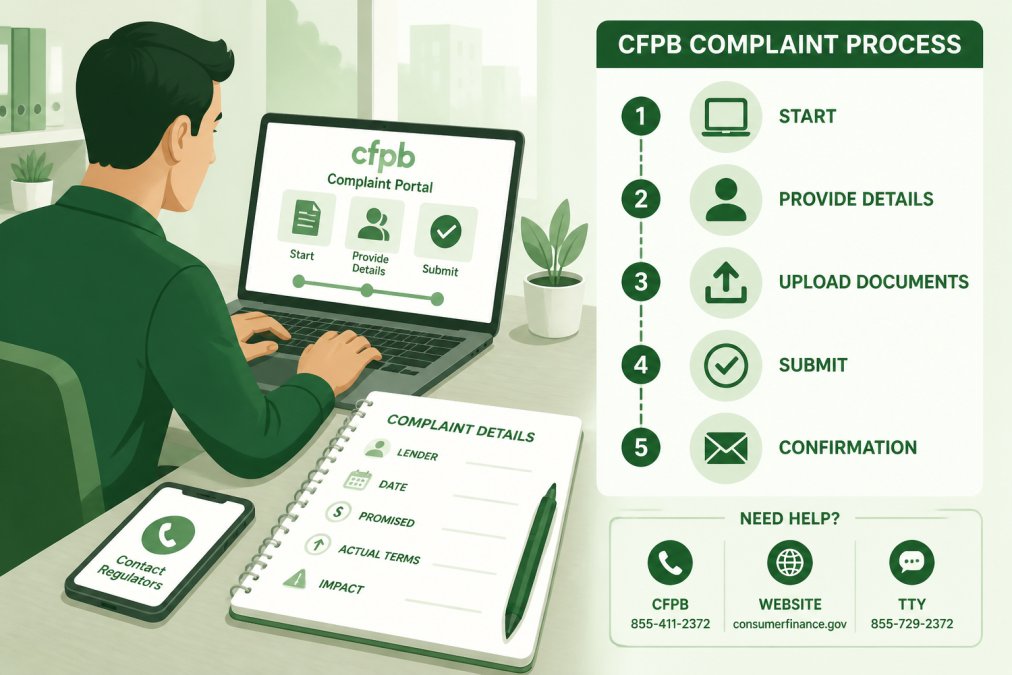
If a lender has deceived you with bait and switch tactics, you have recourse. The Consumer Financial Protection Bureau (CFPB) investigates complaints about lending practices and has authority to take action against lenders who violate consumer protection laws.
Step 1: Document everything. Gather all written communication with the lender: initial loan quotes, the good faith estimate, the loan commitment letter, the closing disclosure, emails showing promises made and terms changed, and records of phone calls. This documentation proves the bait and switch.
Step 2: Understand what constitutes a violation. The Truth in Lending Act (TILA) and the Real Estate Settlement Procedures Act (RESPA) protect borrowers. Violations include misrepresenting loan terms, failing to disclose all fees and costs, changing material terms without written consent, and failing to provide required disclosures on time.
Step 3: File a complaint with the CFPB. You can file online at the CFPB’s complaint portal. The process takes about 15 minutes. You’ll provide your name and contact information, the lender’s details, a description of what happened, key dates, and supporting documents. The CFPB will send your complaint to the lender and give them 15 days to respond.
Step 4: Consider filing a complaint with your state’s attorney general. Most states have a consumer protection division that investigates lending complaints. You can file a complaint in addition to the CFPB complaint.
Document every promise a lender makes in writing. If they later claim they never said something, your documentation proves otherwise. This is your primary defense against bait and switch tactics.
Conclusion: Your Defense Against Bait and Switch Lending
Bait and switch lending exploits the complexity of the loan process and the emotional commitment borrowers develop once deep in a deal. Your defense is threefold: ask the right questions upfront, lock your rate in writing, and compare multiple offers simultaneously. These steps eliminate the lender’s ability to surprise you and give you leverage to negotiate if something does change.
Asset Point Capital removes the conditions that enable bait and switch tactics altogether. By providing firm term sheets within 24 hours and maintaining human-led execution throughout the funding process, the firm eliminates guesswork and ensures transparency from application to closing. Real estate investors working with Asset Point Capital avoid the surprises that plague traditional lending because the terms are locked in and the process is driven by a specific person accountable for delivery.
If you’re seeking real estate financing, the time you invest in comparing offers and asking detailed questions now will save you thousands of dollars and countless hours of stress later. Start by requesting written quotes from at least three lenders. Compare them side by side. Ask every question on the list above. Get everything in writing. Then choose the lender whose terms, timeline, and transparency give you confidence they’ll deliver what they promise.
Apply Now with Asset Point Capital and secure firm terms within 24 hours.
Frequently Asked Questions
What are the most common warning signs of bait and switch lending?
Red flags include a sudden increase in interest rates or fees after initial quotes, pressure to sign documents quickly without time to review, vague or verbal promises that differ from written terms, requests for additional documentation that delays closing, and lenders who become unresponsive after the initial pitch. If your loan estimate changes significantly between application and closing without clear explanation, that's a critical warning sign. Always compare your Loan Estimate form carefully against any revised versions.
How can I protect myself from predatory lending warning signs?
Request a written Loan Estimate within three business days of application and review it thoroughly. Lock your interest rate in writing to prevent unexpected changes. Ask for a detailed breakdown of all fees, including origination fees, underwriting costs, and closing costs. Verify the lender's credentials and check for complaints with the Consumer Financial Protection Bureau (CFPB). Work with lenders who provide firm term sheets upfront rather than conditional quotes that change during the process. Never sign documents you don't fully understand.
What should I do if I suspect my lender has changed the terms of my loan?
Document everything immediately: gather your initial Loan Estimate, all communications with the lender, and the revised terms. Compare the two documents side-by-side to identify specific changes. Contact your lender in writing (email or certified mail) asking for a detailed explanation of each change and requesting a corrected Loan Estimate. If the lender cannot justify the changes or refuses to explain them, you can file a complaint with the CFPB at consumerfinance.gov or contact your state's Attorney General's office. Keep all documentation for potential legal action.
How does the Loan Estimate form help prevent bait and switch tactics?
The Loan Estimate is a standardized three-page form required by federal law that discloses all material loan terms, including interest rate, APR, monthly payment, and all closing costs. By law, lenders cannot change certain terms after you receive this estimate without your permission. Comparing your initial Loan Estimate to the final Closing Disclosure reveals any unauthorized changes. This transparency requirement makes it harder for lenders to hide fees or alter terms without your knowledge, giving you concrete evidence if a bait and switch occurs.
This article was written using GrandRanker