
Table of Contents
- What Is a Commercial Real Estate Term Sheet?
- Key Components of a Commercial Real Estate Term Sheet
- Non-Binding vs. Binding Term Sheet: What’s the Difference?
- Term Sheet vs. Commitment Letter: Key Distinctions
- Red Flags and Negotiation Leverage in Term Sheets
- Using a Commercial Real Estate Term Sheet Template
- Negotiating Commercial Lease Terms and Financing Covenants
- Post-Term Sheet Timeline and Next Steps
Last Updated: August 16, 2026
What Is a Commercial Real Estate Term Sheet?
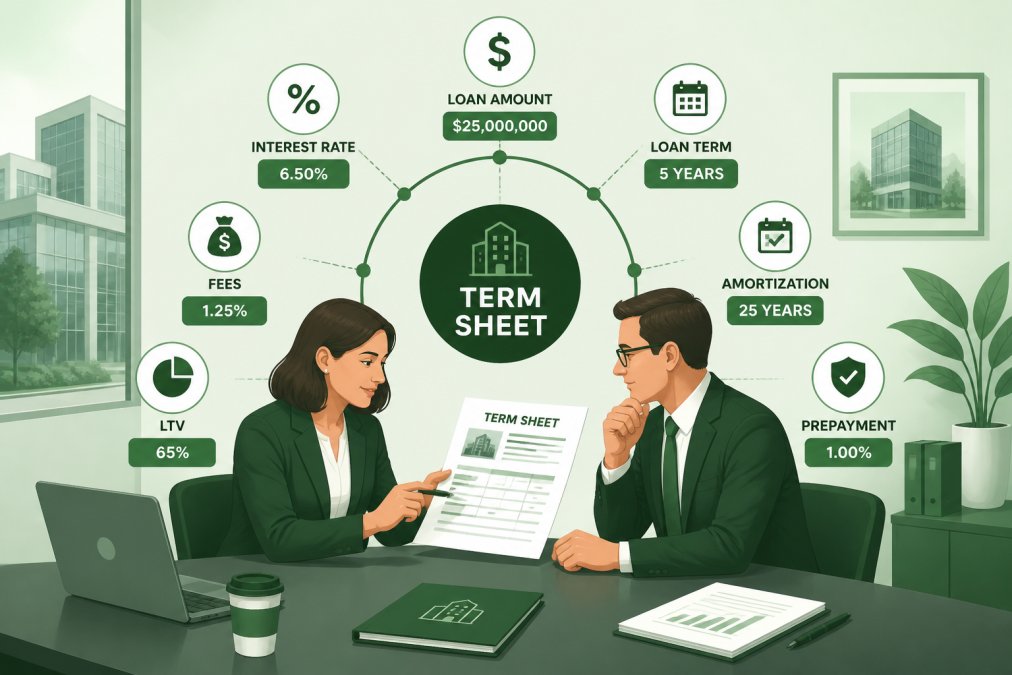
A commercial real estate term sheet is a non-binding document outlining the basic terms and conditions a lender will offer for a commercial real estate loan. It serves as the foundation for negotiations before formal commitment letters and closing documents are prepared, detailing loan amount, interest rate, amortization schedule, prepayment penalties, collateral requirements, and covenants.
For investors and developers, understanding what to look for in a term sheet can mean the difference between securing favorable financing and getting trapped in unfavorable terms that drain returns for years. Most term sheets are non-binding on both parties, though certain provisions like confidentiality may be binding. Understanding which parts are negotiable and which are firm requirements is critical to using the term sheet effectively.

Key Components of a Commercial Real Estate Term Sheet
Certain components appear consistently across term sheets. Knowing what each one means separates borrowers who get good deals from those who accept whatever is offered.
Loan Amount and Structure
The loan amount is straightforward, but structure matters more. Most commercial real estate loans are sized based on either loan-to-value (LTV) or loan-to-cost (LTC).
LTV is calculated by dividing the loan amount by the property value. An 80% LTV on a $5 million property means a $4 million loan. LTC applies to development or construction deals and divides the loan by total project cost. A 90% LTC on a $10 million project funds $9 million.
The term sheet should clearly state which metric applies and what percentage the lender will fund. It should also specify whether the loan is fixed or floating, recourse or non-recourse, and whether it includes mezzanine debt or preferred equity components. For investors focused on cash flow, DSCR Loans are structured specifically around debt service coverage ratio calculations, making them particularly relevant when the term sheet emphasizes income-based underwriting.
Interest Rate and Amortization Schedule
The term sheet should specify whether the rate is fixed for the entire loan term or floating, adjusting periodically based on a benchmark like SOFR plus a spread.
A critical detail: the term sheet should specify the loan term separately from the amortization period. You might have a 5-year loan term with a 25-year amortization, meaning you make payments as if paying off the loan over 25 years, but the entire remaining balance is due at the end of year 5 (the balloon payment).
Ask whether the rate includes an origination fee or discount points baked in. Some lenders quote competitive rates but charge substantial upfront fees that effectively raise your true cost.
Prepayment Penalties and Yield Maintenance
Prepayment penalties protect the lender if you pay off the loan early. They come in several forms: straight prepayment penalties (a percentage of the outstanding balance), yield maintenance (the lender gets compensated for lost interest), or defeasance (you replace the collateral property with Treasury securities).
The term sheet should specify which type applies, the penalty amount or formula, and any windows where prepayment is allowed without penalty. This matters enormously if you’re planning to sell the property, refinance, or exit within a specific timeframe.
Recourse vs. Non-Recourse Provisions
Recourse liability means the lender can pursue you personally if the property doesn’t generate enough proceeds to cover the loan. The lender can go after your other assets, not just the collateral.
Non-recourse limits the lender’s claim to the property itself. If the property sells for less than the loan balance, that’s the lender’s loss. Non-recourse loans carry higher interest rates because the lender bears more risk. The term sheet should clearly state whether the loan is recourse or non-recourse, and if non-recourse with carveouts, those carveouts must be explicitly listed.
Escrow and Reserve Requirements
Escrow and reserve accounts are funds held by the lender to cover certain costs. Property taxes and insurance are often escrowed, meaning you pay a monthly amount to the lender who then pays these bills. Reserves might include capital reserves for tenant improvements, leasing commissions, or major repairs.
The term sheet should specify the initial escrow and reserve amounts, how they’re calculated, and when they’re released. A lender demanding excessive reserves is essentially asking you to fund their risk mitigation, a red flag that they’re concerned about the deal.
Non-Binding vs. Binding Term Sheet: What’s the Difference?
Most commercial real estate term sheets are non-binding agreements, meaning neither party is legally obligated to proceed. The term sheet expresses intent but isn’t a contract. Either party can walk away without penalty, though confidentiality clauses typically remain binding.
A non-binding term sheet serves as a starting point for due diligence and negotiation. However, certain provisions within a non-binding term sheet may be binding, typically including confidentiality clauses, exclusivity agreements, and expense reimbursement terms.
A binding term sheet is rare in commercial real estate but does occur, creating legal obligations on both parties and typically including a specific closing date, earnest money deposit, and penalties for backing out. Always confirm which type you’re signing and understand the implications of any binding provisions.
Term Sheet vs. Commitment Letter: Key Distinctions
A term sheet is preliminary and typically non-binding. It outlines basic terms and is issued early to establish whether a deal is feasible.
A commitment letter is formal and binding on the lender. It’s issued after full underwriting and due diligence are complete, specifying exact loan terms and conditions that must be satisfied before funding. The commitment letter includes detailed conditions: property appraisal must meet minimum value, title insurance must be clear, environmental reports must show no Phase I issues, and borrower financial statements must be verified.
Think of the term sheet as "we’re interested" and the commitment letter as "we’re committed, pending these conditions." The progression represents increasing certainty and decreasing flexibility for negotiation.
Red Flags and Negotiation Leverage in Term Sheets
Not all term sheets are created equal. Some lenders use them as bait-and-switch tools, offering attractive initial terms that change dramatically by commitment letter.
Red Flags to Watch For
Vague interest rate or pricing. If the term sheet says "rate to be determined" or "pricing based on final underwriting," you don’t have a real term sheet. A credible lender provides a range or a specific rate with clear conditions.
Excessive prepayment penalties. A 5% penalty in year one declining to 1% by year five is reasonable. A 10% penalty throughout the loan term or defeasance requirements that lock you in are signs the lender doesn’t expect you to perform.
Undefined covenants. Covenants are rules you must follow: minimum debt service coverage ratio (DSCR), maximum loan-to-value, restrictions on capital calls, limits on additional debt. Vague covenants give the lender subjective power to declare a default.
Broad indemnification clauses. Reasonable indemnification covers specific risks like environmental liability or title defects. Broad indemnification that covers "any claim arising from the loan or property" exposes you to unlimited liability.
Excessive escrow or reserve amounts. If the lender demands 12 months of reserves for property taxes, insurance, and maintenance on a stabilized asset, they’re signaling concern about your ability to service debt. Standard reserves are 3-6 months.
Floating rate without a cap. If the rate floats without an interest rate cap, your payment could increase dramatically if rates rise. Always negotiate for a cap if the rate floats.
Personal guarantees on non-recourse loans. A non-recourse loan shouldn’t require a personal guarantee on the full loan amount. Negotiate limited guarantees covering only specific carveouts.
Negotiation Leverage Checklist
Assess your position. Are you a strong borrower with excellent credit, significant equity, and a stabilized asset? You have leverage. Are you a first-time investor with minimal track record? You have less leverage.
Know market rates. Research what similar lenders are charging for similar deals. If your term sheet is 200 basis points above market, you have a concrete reason to negotiate.
Identify what matters most. You can’t negotiate everything. Prioritize 2-3 issues and be willing to concede on others.
Propose specific alternatives. Don’t just say "this rate is too high." Propose "I’ll accept your rate if you reduce the prepayment penalty from 5% to 2%."
Use timing as leverage. If you’re under contract to purchase a property with an approaching closing date, both you and the lender have time pressure.
Document everything. If the lender verbally agrees to modify a term, get it in writing in the commitment letter.
Walk away if necessary. Credible willingness to find another lender is your best negotiating tool.
Using a Commercial Real Estate Term Sheet Template
A template helps you understand what to expect and what to look for, including sections for loan amount, rate, amortization, prepayment penalties, recourse provisions, covenants, escrow, and conditions to closing.
However, templates are starting points, not substitutes for legal review. Every deal is different. Work with a real estate attorney who can review the specific term sheet for your deal and flag issues a template wouldn’t catch.
Negotiating Commercial Lease Terms and Financing Covenants
Financing covenants often interact with lease terms, particularly in income-producing properties. The lender will scrutinize lease terms because they affect the property’s ability to service debt.
Lease length matters. A lender prefers long-term leases (5+ years) because they provide income stability. Short-term leases create vacancy risk.
Rent escalation clauses affect DSCR calculations. The debt service coverage ratio is calculated as net operating income divided by annual debt service. Leases with annual escalations (typically 2-3%) provide cushion against rising debt service.
Tenant creditworthiness affects underwriting. Strong tenants make the loan easier to underwrite and may qualify for better rates. Weak tenants increase risk and may require higher reserves.
Lease subordination. The lender will require that their mortgage be superior to tenant leases. Negotiate lease language to ensure this is clear.
Renewal and expansion options. Leases with renewal options or expansion rights are more valuable to lenders because they provide income predictability.
Post-Term Sheet Timeline and Next Steps
After you receive and sign a term sheet, the process moves to underwriting and due diligence.
Days 1-3: Initial review and negotiation. Review the term sheet with your attorney and accountant. Identify issues and propose modifications.
Days 4-7: Property due diligence begins. Order appraisal, environmental report, title search, and property inspection.
Days 8-14: Underwriting review. The lender reviews your financial statements, tax returns, credit report, and property documents. For development or acquisition projects, Real Estate Investment Loans and Bridge Loans may be evaluated during this phase depending on your project timeline and structure.
Days 15-21: Appraisal and environmental review. Results come back. If the appraisal is lower than expected, the loan amount might be reduced.
Days 22-28: Commitment letter issuance. If everything checks out, the lender issues a commitment letter with specific conditions.
Days 29-closing: Final documentation and funding. Legal counsel prepares loan documents and you satisfy final conditions.
This timeline assumes smooth underwriting. Complications extend it.
Understanding what to look for in a commercial real estate term sheet transforms you from a passive borrower accepting whatever is offered into an active negotiator who secures favorable terms. The term sheet is your first real glimpse into the lender’s actual requirements and risk appetite. Reading it carefully, identifying red flags, and negotiating strategically can save you tens of thousands in interest, penalties, and restrictive covenants over the life of the loan. Prioritizing transparency and human execution over automated systems and bait-and-switch tactics ensures you move quickly when you find the right financing partner.
Frequently Asked Questions
What should a commercial real estate term sheet include?
A complete term sheet covers loan amount and structure, interest rate with amortization schedule, prepayment penalties or yield maintenance, recourse vs. non-recourse liability, escrow and reserve requirements, loan-to-value ratio, debt service coverage ratio requirements, covenants and default provisions, due diligence period, closing costs, and the lender's underwriting timeline. The specifics vary by property type and deal structure, but these elements protect both borrower and lender and define the actual terms of your financing.
Is a commercial real estate term sheet legally binding?
Not necessarily. Most term sheets are labeled non-binding agreements, meaning they outline the lender's intent but don't lock either party into the deal. However, some provisions, like confidentiality or exclusivity clauses, may be binding. The commitment letter that follows is typically binding. Always review whether your term sheet explicitly states binding vs. non-binding status, and have legal counsel confirm which clauses apply to you before proceeding.
What is the difference between a term sheet and a commitment letter?
A term sheet is a non-binding outline of proposed lending terms issued early in the process, often within 24 hours of application. A commitment letter is a binding agreement issued after underwriting and due diligence, confirming the lender will fund at the stated terms. The commitment letter includes more detail, conditions, and legal language. Think of the term sheet as the lender's initial offer; the commitment letter is the contract you sign before closing.
What are the most critical sections to focus on when reviewing a term sheet?
Prioritize loan amount and loan-to-value ratio, interest rate (fixed vs. floating), amortization schedule, prepayment penalties, recourse liability, debt service coverage ratio requirements, and default provisions. These sections determine your total cost, monthly payment, exit flexibility, and personal liability. Misalignment on any of these can cost tens of thousands or expose you to unexpected risk. Have a real estate attorney or financial advisor review these sections before signing.
What red flags should I watch for in a commercial real estate term sheet?
Watch for vague due diligence timelines, unusually high interest rate caps on floating-rate loans, prepayment penalties that extend beyond your exit timeline, broad recourse clauses that expose personal assets, excessive escrow holdbacks, or covenants that restrict your ability to refinance or sell. Also flag any terms that differ materially from the initial quote or that include undefined terms like 'market conditions.' If the lender won't explain or negotiate these items, that signals risk.
How do I negotiate key provisions in a commercial real estate term sheet?
Start with your debt service coverage ratio and loan-to-value requirements, these directly affect your deal's viability. Then negotiate interest rate, prepayment penalties, and recourse provisions based on comparable deals and your credit profile. Use your loan-to-value ratio and cash reserves as leverage. Request removal of unnecessary covenants and clarify ambiguous language before signing. Having multiple lender options strengthens your position; a lender offering firm terms within 24 hours gives you concrete leverage to negotiate with others.
What does non-binding vs. binding mean in a term sheet?
Non-binding means the lender is not legally obligated to fund at those terms if conditions change, they can walk away or revise terms during underwriting. Binding means the lender commits to funding at the stated terms unless you breach a condition. Most initial term sheets are non-binding to protect the lender during due diligence. The commitment letter that follows is typically binding. Always confirm the status in writing and understand which clauses (like exclusivity) might be binding even if the overall sheet is not.
What is a loan-to-value ratio, and why does it matter in a term sheet?
Loan-to-value ratio is the loan amount divided by the property's appraised value, expressed as a percentage. A 75% LTV means you're borrowing 75% of the property's value. This ratio determines how much equity you need and affects your interest rate, prepayment terms, and recourse liability. Higher LTV (up to 80-90% for some programs) means less cash down but higher risk for the lender, so rates may be higher. Negotiating your LTV directly impacts your deal's profitability and your personal exposure.
This article was written using GrandRanker