
Table of Contents
- What Is a DSCR Loan and Why Finding the Right Lender Matters
- DSCR Loan Requirements: What Lenders Actually Evaluate
- How to Qualify for a DSCR Loan: The Underwriting Process
- DSCR Loan vs Conventional Loan: Why Investors Choose DSCR
- Step-by-Step: How to Find DSCR Loan Lenders
- Red Flags and Pitfalls When Selecting DSCR Lenders
- Broker vs Direct Lender: Which Path Gets You Funded Faster
- Conclusion
Last Updated: August 14, 2026
What Is a DSCR Loan and Why Finding the Right Lender Matters
A debt service coverage ratio (DSCR) loan is financing designed for real estate investors where the property’s rental income, not personal income, determines borrowing capacity. The DSCR measures whether a property generates enough cash flow to cover its debt obligations. Lenders evaluate this ratio to assess risk: properties with strong cash flow qualify for larger loans and better terms.
Finding the right lender matters because the DSCR lending market has fragmented dramatically. Some lenders specialize in single-family rentals, others in multifamily complexes or commercial properties. Terms, closing timelines, and underwriting flexibility vary wildly. Many lenders use aggressive bait-and-switch tactics, offering attractive initial terms, then tightening requirements mid-process when you’re locked into a timeline. The cost of choosing poorly is real: missing a closing deadline means losing earnest money, and accepting unfavorable terms locks you into higher interest rates for years. Asset Point Capital addresses this through a hybrid model combining direct capital with access to over 1,025 niche market options, matching your specific property profile to programs designed for it rather than forcing your deal into a one-size-fits-all program.
DSCR Loan Requirements: What Lenders Actually Evaluate
DSCR lenders evaluate your deal through a different lens than conventional mortgage lenders. Instead of focusing on your personal credit score and W-2 income, they analyze the property’s ability to service debt.
The core calculation: A property’s DSCR is annual rental income divided by annual debt service (principal plus interest payments). A DSCR of 1.25 means the property generates 25% more income than required to cover loan payments. Most lenders require a minimum DSCR of 1.0 to 1.25, depending on the property type and their risk appetite.
Beyond the ratio itself, lenders evaluate several factors:
Property appraisal and loan-to-value ratio. Lenders order an appraisal to establish the property’s value, then calculate how much they’ll lend based on that valuation. Most DSCR lenders offer loan-to-value (LTV) ratios between 70-80%, meaning you’ll need 20-30% down. Some portfolio lenders push this to 85-90% LTC (loan-to-cost), particularly for construction or fix-and-flip scenarios.
Rental income documentation. For stabilized rental properties, lenders typically want 12-24 months of actual rent rolls and bank statements showing deposits. For new construction or properties without rental history, they use market rent estimates based on comparable properties.
Credit score and personal reserves. While credit matters less than with conventional loans, most lenders require a minimum score between 620-680. Personal reserves matter significantly, as lenders want evidence you can cover a payment if the property experiences vacancy or unexpected repairs.
Property type and condition. Lenders categorize properties as stabilized (performing, fully rented), transitional (recently acquired, being repositioned), or construction (new build or major renovation). Each category has different underwriting rules.
Amortization and prepayment terms. DSCR loans often feature interest-only periods (typically 6-12 months) before principal and interest payments begin. Understanding prepayment penalties matters too, as this affects your exit strategy.
How to Qualify for a DSCR Loan: The Underwriting Process
DSCR underwriting differs from conventional mortgage underwriting in speed and documentation focus.
Initial application and term sheet. You provide basic deal information: property address, purchase price, estimated rental income, and your down payment. Most lenders issue a non-binding term sheet within 24-48 hours. Asset Point Capital delivers firm term sheets within 24 hours, eliminating guesswork about whether your deal qualifies before you commit resources.
Property appraisal. The lender orders a full appraisal, typically taking 7-10 days for stabilized properties. The appraisal determines the maximum loan amount available.
Rental income and cash flow verification. For stabilized properties, submit 12-24 months of rent rolls and corresponding bank deposits. For new construction, the lender uses market rent comparables. For transitional properties, lenders typically apply a discount to projected income to account for vacancy risk.
Personal financial documentation. Prepare bank statements (typically 2-3 months of history), tax returns (1-2 years), and identification. The lender wants to verify your liquid reserves and personal financial stability.
Title search and insurance. The lender’s title company conducts a search to ensure the property has clear title and no liens that would take priority over the mortgage.
Final underwriting and conditions. The underwriter reviews all documentation, issues a conditional approval, and lists any final items needed before funding. This stage typically takes 5-7 days.
Clear to close. Once all conditions are satisfied, the lender issues a clear-to-close status. You coordinate with the title company, wire your down payment and closing costs, and sign final documents. Funding typically occurs 1-3 business days after signing.
The entire process typically takes 2-4 weeks for experienced lenders managing straightforward deals.
DSCR Loan vs Conventional Loan: Why Investors Choose DSCR
Conventional mortgages require strong personal income verification and typically allow borrowing on only 1-4 properties. DSCR loans operate differently, which is why real estate investors increasingly prefer them.
Income qualification. Conventional lenders want to see W-2 income or employment verification. If you’re a full-time investor without W-2 income, conventional lending becomes difficult. DSCR lenders ignore personal income entirely, caring only about the property’s cash flow.
Property portfolio limits. Fannie Mae and Freddie Mac restrict borrowers to four financed properties. DSCR lenders have no such limits, allowing investors building portfolios of 10, 20, or 50 properties to access financing.
Loan-to-value flexibility. Conventional mortgages typically max out at 80% LTV for investment properties. DSCR lenders frequently offer 85-90% LTC for construction and fix-and-flip deals, preserving more of your capital for other investments.
Speed and execution. DSCR lenders targeting investor clients often move faster than conventional lenders. DSCR lenders have more flexibility to adjust timelines and accommodate time-sensitive acquisitions.
Stabilized rental property economics. For a stabilized rental property generating strong cash flow, DSCR loans often provide better economics than conventional mortgages. The property’s performance, not your tax returns, drives the decision.
The trade-off: DSCR loans typically carry higher interest rates than conventional mortgages, reflecting the lender’s higher risk and specialized nature. For investors, this premium is worth paying because it unlocks financing otherwise unavailable.
Step-by-Step: How to Find DSCR Loan Lenders
Finding qualified DSCR lenders requires a structured approach.

Step 1: Identify Your Deal Profile and Lender Type
Before searching for lenders, define your deal precisely. Document your deal profile: property type (single-family, multifamily, commercial), property status (stabilized, transitional, construction), estimated DSCR, down payment percentage, and timeline.
Next, identify lender types. Direct lenders fund loans from their own capital. Mortgage brokers connect borrowers with multiple lenders and earn commissions. Portfolio lenders hold loans long-term, giving them flexibility to underwrite creatively. Non-QM (non-qualified mortgage) lenders specialize in borrowers who don’t fit conventional lending boxes. Each type has trade-offs: direct lenders often move faster but may have narrower criteria; brokers access more programs but take longer to coordinate; portfolio lenders offer flexibility but may charge higher rates.
Step 2: Vet Lenders for Credibility and Speed
Not all lenders are equal. Some operate with integrity and deliver on promises. Others use aggressive sales tactics, then tighten terms mid-process when you’re committed.
Start with basic credibility checks. Is the lender licensed in your state? Do they have a physical office and verifiable contact information? Can you find them on the NMLS (Nationwide Multistate Licensing System) database? Absence from NMLS is a red flag.
Request references from recent deals. Call those investors directly and ask: Did they close on time? Were there surprise fee increases or term changes? Would you use them again?
Evaluate speed claims carefully. Ask for the lender’s actual average closing timeline from application to funding, based on recent deals. Request a sample term sheet showing their standard rates and fees. Compare term sheets from three lenders to spot patterns.
Look for transparency around fees. Legitimate lenders disclose origination fees, underwriting fees, appraisal costs, and title insurance upfront. If a lender is vague about fees, that’s a warning sign.
Step 3: Request Term Sheets and Compare Offers
Once you’ve identified 2-3 credible lenders, request formal term sheets. Provide consistent information to each lender so comparisons are valid.
A term sheet should include: loan amount, interest rate, loan term (amortization), prepayment penalties, origination fee, underwriting fee, appraisal cost estimate, and estimated closing timeline. Clarify whether the rate is locked once you receive the term sheet, or only after formal application.
Compare the total cost, not just the interest rate. For a stabilized property with strong cash flow, you might qualify for both DSCR and conventional financing. Run the numbers on each to see which makes sense for your deal.
Step 4: Evaluate Closing Timeline and Execution
The fastest term sheet doesn’t matter if execution is slow. Ask specific questions: How long for the appraisal? When does underwriting begin, after appraisal or in parallel? What’s the average time from clear-to-close to funding? Do they work with a specific title company, or can you use yours?
Request a written timeline from each lender showing estimated dates for each step. Then ask: What happens if the appraisal comes in low? How do you adjust? What if I need to close five days earlier than planned? Lenders’ answers reveal flexibility.
The best lender combines three qualities: credible underwriting, transparent terms, and reliable execution. Asset Point Capital’s hybrid model means your deal gets matched to a program designed for it, not forced into a generic box. Firm term sheets within 24 hours eliminate uncertainty about whether you qualify before you invest time and money.
Red Flags and Pitfalls When Selecting DSCR Lenders
Certain warning signs indicate a lender you should avoid.
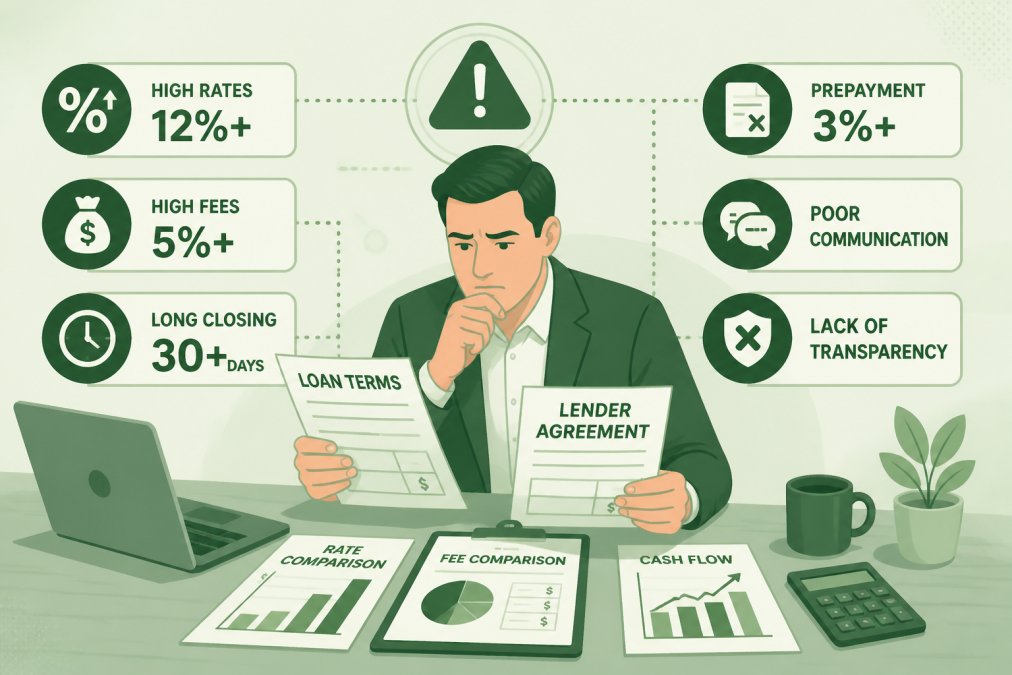
Bait-and-switch on rates and fees. A lender quotes one rate and fee, you apply, and suddenly both increase. Legitimate lenders lock rates after application or clearly state the rate is an estimate pending appraisal. If a lender won’t lock terms in writing, walk away.
Pressure to commit before full disclosure. Some lenders push for earnest money or application fees before providing a complete term sheet. Legitimate lenders provide term sheets before asking for money.
Vague or constantly changing timelines. A lender says "7-10 days to close," but when you ask for specifics, the answer is fuzzy. Reliable lenders provide written timelines and communicate proactively when delays occur.
Unwillingness to work with your attorney or title company. If a lender forbids you from using your attorney or title company without a legitimate reason, that’s controlling behavior worth questioning.
Aggressive collection of personal financial information. DSCR lenders need some personal financial documentation to verify reserves. But if a lender requests extensive personal financial detail before you’ve even applied, or demands account access, that’s excessive.
No clear point of contact. You get bounced between loan officers, processors, and underwriters with no single person responsible for your deal. Good lenders assign a dedicated contact who coordinates your entire process.
Disappearance during execution. The lender is responsive during the sales phase but goes silent once you’re in underwriting. This suggests the lender is overloaded or deprioritizing your deal.
Unrealistic DSCR requirements for your property type. A lender demands 1.5 DSCR for a transitional property. That’s unrealistic; transitional properties typically generate lower cash flow during repositioning.
Broker vs Direct Lender: Which Path Gets You Funded Faster
The broker versus direct lender decision affects both speed and economics.
Direct lenders fund loans from their own capital. Advantages: faster approval (no middleman), consistent underwriting standards, and direct communication. Disadvantages: narrower lending criteria and potentially higher rates (no competitive pressure).
Brokers don’t lend. They take your application, shop it to multiple lenders, and coordinate with the lender who offers the best terms. Advantages: access to many programs, competitive rates, and flexibility. Disadvantages: slower process, less direct communication, and potential conflicts of interest.
Speed comparison: For straightforward deals, direct lenders often close faster because there’s no coordination overhead. For complex deals or unusual property types, brokers sometimes find solutions faster because they access more programs.
Economics comparison: Brokers’ rates are often competitive because they shop multiple lenders. Direct lenders may have higher rates because they face no competitive pressure. Run the math on both approaches for your specific deal.
Hybrid approach: Some lenders combine direct capital with access to numerous niche market options. This hybrid model offers speed of direct lending with the program diversity of brokers. You get a firm term sheet quickly, and if your deal doesn’t fit their direct program, you’re matched to one of 1,025+ specialized lenders without losing time to broker coordination.
The right choice depends on your deal complexity and timeline.
Finding the right DSCR loan lender determines whether your investment deal closes on schedule and on favorable economics. The process requires defining your deal profile, vetting lenders for credibility, comparing term sheets, and evaluating execution capability. Common pitfalls, bait-and-switch tactics, unclear timelines, and poor communication, can derail deals. Whether you choose a broker, direct lender, or hybrid approach depends on your deal complexity and timeline. Move deliberately: research credibility, lock terms in writing, and verify execution before committing earnest money. Asset Point Capital’s firm term sheets within 24 hours and human-led execution eliminate guesswork and bait-and-switch risk, ensuring you can move from application to funding in as little as 2-3 weeks while securing the best terms for your deal.
Frequently Asked Questions
What credit score do you need for a DSCR loan?
DSCR lenders typically require a minimum credit score between 620 and 680, though some portfolio lenders accept scores as low as 580. However, credit score is just one factor in underwriting. The property's debt service coverage ratio, how rental income covers the annual debt service, often matters more than personal credit. Investors with strong cash flow and reserves can sometimes qualify with lower credit scores, while those with weaker rental income may need higher scores to offset the risk.
How do lenders calculate DSCR for investment properties?
DSCR is calculated by dividing the property's gross monthly rental income by the total monthly debt service (principal, interest, taxes, insurance, and HOA fees). For example, a property generating $5,000 monthly rent with $3,500 in monthly debt obligations has a DSCR of 1.43. Most lenders require a minimum DSCR of 1.0 to 1.25, meaning rental income must cover 100% to 125% of debt payments. Some lenders assess DSCR on stabilized rental income projections rather than current income, which can help newer or partially occupied properties qualify.
How difficult is it to get a DSCR loan compared to a conventional mortgage?
DSCR loans are generally easier to qualify for than conventional mortgages because they focus on property cash flow rather than personal income verification. You don't need to prove W-2 income or tax returns. However, the property must demonstrate sufficient rental income to cover debt payments. The trade-off is that DSCR loans typically carry higher interest rates and larger down payments (15-25%) than conventional loans. The timeline is also faster, many lenders fund DSCR loans in 2-3 weeks compared to 30-45 days for conventional financing.
What should I ask a DSCR lender before committing?
Always ask about the lender's timeline from application to funding, whether there are prepayment penalties, how they handle rate locks, and what happens if the property appraisal comes in lower than expected. Ask specifically about their underwriting guidelines for your property type (short-term rental, long-term rental, commercial) and whether they'll work with non-standard deals. Request references from recent borrowers and confirm they provide firm term sheets rather than preliminary estimates. Finally, clarify all closing costs upfront and whether the lender will fund even if your closing date shifts.
This article was written using GrandRanker