
Table of Contents
- What Is a Bridge Loan?
- What Is a DSCR Loan?
- DSCR Loan Requirements and Qualification Criteria
- Bridge Loan Interest Rates and Cost Structure
- Key Differences: Bridge vs. DSCR Loans
- Refinancing Bridge Loans to Long-Term Debt
- When to Use a Bridge Loan vs. a DSCR Loan
- Conclusion
Last Updated: August 13, 2026
What Is a Bridge Loan?
A bridge loan is short-term financing that "bridges" the gap between buying a new property and selling an existing one. Real estate investors, developers, and property owners use bridge loans to close quickly on time-sensitive acquisitions without waiting for long-term mortgage approval or the sale of a current property.
Bridge loans typically have terms ranging from 6 to 24 months. The structure prioritizes speed over traditional underwriting. Lenders focus on the property’s value and the borrower’s exit strategy, usually the sale of an existing property or refinancing into permanent debt, rather than income verification or credit scores.
The mechanics are straightforward. You borrow against the equity in your current property or the value of the property you’re acquiring. You make interest-only payments during the loan term. When your exit event occurs (property sale, refinance, or permanent financing), you repay the principal in full.
What Is a DSCR Loan?
A DSCR loan (Debt Service Coverage Ratio loan) is a long-term, income-based financing product designed for income-producing properties. The lender approves the loan based on the property’s cash flow, specifically, how much revenue the property generates relative to its debt obligations, rather than the borrower’s personal income.
DSCR loans work differently than traditional mortgages. Instead of verifying your W-2 income or tax returns, the lender calculates the debt service coverage ratio: the property’s annual net operating income divided by the annual debt service (principal and interest payments). Most lenders require a DSCR of 1.2 or higher, meaning the property must generate at least 20% more income than the loan payments.
This structure makes DSCR loans particularly valuable for self-employed investors, real estate professionals with irregular income, or borrowers managing multiple properties. The loan approval hinges on the asset’s performance, not the borrower’s personal financial profile. Terms typically range from 5 to 30 years, with fixed or adjustable rates available.
DSCR Loan Requirements and Qualification Criteria
DSCR loan requirements differ fundamentally from traditional mortgage standards. Lenders evaluate the property first, the borrower second.
Income Documentation: Instead of personal tax returns or W-2s, you’ll provide the property’s last 2 years of tax returns or operating statements. For new construction or value-add projects still stabilizing, some lenders accept proforma financials (projected income based on comparable properties or business plans).
Debt Service Coverage Ratio: Most lenders require a minimum DSCR of 1.2, though some programs go as low as 1.0 for strong borrowers or stabilized properties. A DSCR below 1.0 means the property doesn’t cover its own debt service, a red flag for traditional lenders, though some specialized programs accept this with compensating factors.
Loan-to-Value (LTV) and Loan-to-Cost (LTC): DSCR lenders typically cap LTV at 75-80% for stabilized properties, and LTC at 85-90% for construction or value-add projects. These ratios protect the lender if the property value declines or the project runs over budget.
Credit Score: DSCR lenders are more flexible on credit than traditional mortgage lenders. Many approve borrowers with credit scores as low as 620-640, though stronger scores improve terms. Some lenders offer no-credit-pull quotes for initial underwriting.
Property Type: DSCR loans work for rental homes, multifamily buildings, commercial office, retail, hospitality, and mixed-use properties. Owner-occupied properties don’t qualify, the property must generate income independent of the borrower living there.
Cash Reserves: Lenders often require 6-12 months of PITI (principal, interest, taxes, insurance) in reserves, though this varies by program and borrower strength.
Bridge Loan Interest Rates and Cost Structure
Bridge loan costs reflect their speed and flexibility. Interest rates are higher than traditional mortgages but vary based on the lender, property type, loan amount, and exit strategy certainty.
Interest Rates: Bridge loans typically carry interest rates 2-4 percentage points above conventional mortgage rates. If a traditional 30-year fixed mortgage is 6%, expect bridge rates in the 8-10% range, depending on market conditions and lender risk assessment.
Origination Fees: Expect to pay 1-3% of the loan amount in origination fees. A $500,000 bridge loan might carry $5,000-$15,000 in upfront fees.
Points: Some bridge lenders charge discount points (1 point = 1% of the loan amount) to buy down the interest rate. This is optional but common for borrowers who plan to hold the bridge loan longer than 12 months.
Prepayment Penalties: Many bridge lenders impose prepayment penalties if you repay early, typically 1-2% of the outstanding balance if you pay off within the first 6-12 months. This protects the lender’s expected return and incentivizes longer-term loans.
Appraisal and Due Diligence Costs: Expect $500-$2,000 in appraisal fees plus potential inspection, title, and underwriting costs. These are often rolled into the loan or paid at closing.
Interest-Only Payments: During the bridge term, you typically pay interest only, no principal reduction. A $500,000 bridge loan at 9% interest costs approximately $37,500 annually, or $3,125 monthly, with no equity buildup.
The total cost of a bridge loan reflects its speed and certainty. You’re paying a premium for capital that closes in 2-3 weeks rather than 45-60 days, and for lenders who accept deals traditional banks reject.
Key Differences: Bridge vs. DSCR Loans
The fundamental distinction between these two loan types comes down to timeline and qualification basis. Bridge loans prioritize speed; DSCR loans prioritize long-term income stability.

Loan Purpose and Use Case: Bridge loans fund acquisition and holding periods before a refinance or property sale. DSCR loans fund the long-term ownership of income-producing assets. If you need capital for 6-18 months while waiting for a permanent exit, bridge financing is designed for that. If you’re acquiring a rental property you’ll hold for 5+ years, a DSCR loan is the permanent solution.
Underwriting Focus: Bridge lenders evaluate the exit strategy and property value. They ask: "Can the borrower sell this property or refinance into permanent debt within our loan term?" DSCR lenders evaluate the property’s cash flow. They ask: "Does this asset generate enough income to cover its debt service and provide a safety margin?"
Income Requirements: Bridge loans don’t require income documentation. You could have zero income and still qualify for a bridge loan if the property value and exit strategy are sound. DSCR loans require the property to demonstrate income, either historical (through tax returns) or projected (through proforma financials for new construction).
Loan Term and Structure: Bridge loans are short-term, typically 6-24 months, with interest-only payments. DSCR loans are long-term, typically 5-30 years, with principal and interest amortization. This structural difference shapes the entire borrowing experience.
Cost: Bridge loans carry higher interest rates (8-10%+) and origination fees (1-3%) because they’re riskier and faster. DSCR loans carry lower rates (5-8%) because they’re backed by stabilized, income-producing assets held long-term.
Exit Strategy: Bridge loans require a defined exit, you must have a plan to repay within the loan term. DSCR loans don’t require an exit; you can hold the property indefinitely and refinance if rates improve.
Flexibility on Credit and Income: Bridge lenders care little about your personal credit or income. DSCR lenders are more flexible on credit (accepting 620+ scores) but require the property to perform.
Refinancing Bridge Loans to Long-Term Debt
The bridge-to-permanent refinance is one of the most common exit strategies in real estate investing. Understanding this pathway is critical for managing bridge loan costs and avoiding costly delays.
The Refinance Timeline: Most bridge loans include a "bridge-to-perm" option, allowing you to refinance into permanent debt before the bridge term expires. This typically happens 6-12 months into the bridge loan, once the property is stabilized or the value-add project is substantially complete.
Stabilization and Appraisal: Lenders won’t refinance into a long-term DSCR loan until the property has a track record of generating income. For rental properties, this usually means 6 months of actual lease agreements and rent collection. For value-add or fix-and-flip projects, you’ll need to demonstrate completion and occupancy. A new appraisal is required, and the property value must support the refinance amount.
Income Documentation: When refinancing from bridge to DSCR, you’ll shift from property-value-based underwriting to income-based underwriting. You’ll provide 2 years of property tax returns, operating statements, or proforma financials showing the stabilized income. For new construction, appraisers and lenders rely on comparable rent rates in the market.
Rate and Term: The permanent DSCR loan will carry a lower interest rate than the bridge loan, typically 200-300 basis points lower, depending on market conditions. You’ll also move from interest-only payments to a full amortization schedule, which means higher monthly payments but equity buildup and predictable payoff.
Timing Risk: The bridge-to-perm refinance introduces timing risk. If property values decline, interest rates spike, or the property fails to stabilize on schedule, refinancing may be delayed or require renegotiation. Experienced investors build contingency time into their bridge loan terms to avoid forced extensions at higher rates.
Prepayment Penalty Avoidance: Many bridge lenders waive prepayment penalties if you refinance into a permanent loan with them or a partner lender. Clarify this in your bridge loan terms to avoid surprise penalties when you refinance.
Asset Point Capital’s hybrid lending model, combining direct capital with access to over 1,025 niche market options, allows investors to lock in permanent financing terms before the bridge closes, eliminating refinance uncertainty. Firm term sheets issued within 24 hours mean you know your exit cost before committing to the bridge.
When to Use a Bridge Loan vs. a DSCR Loan
The right financing tool depends on your timeline, property type, and exit strategy.
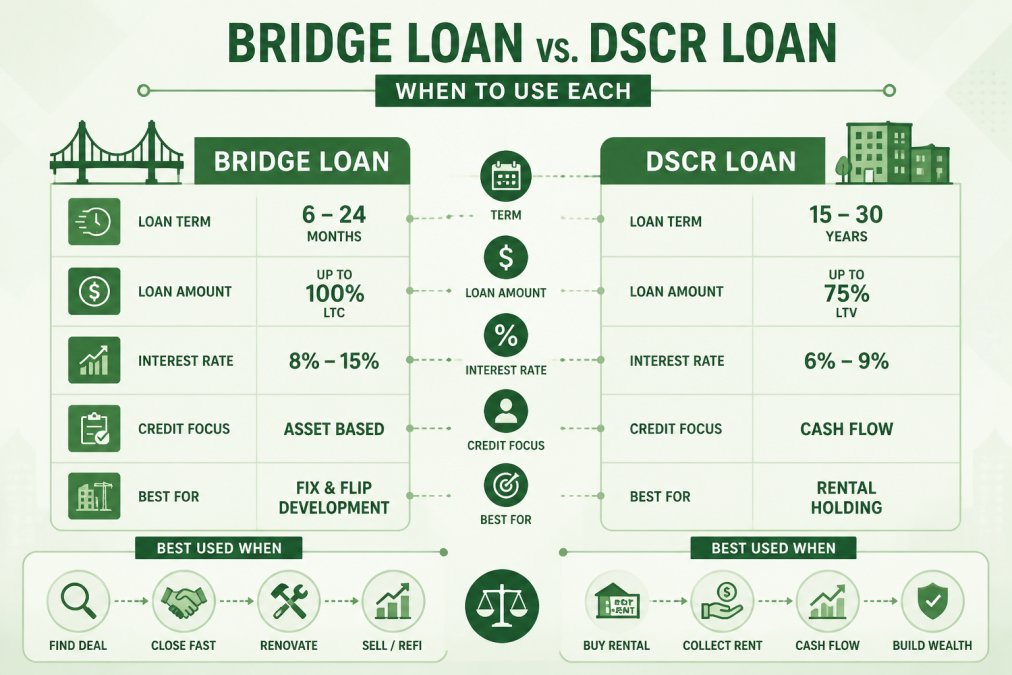
Use a Bridge Loan When:
You’re in a time-sensitive acquisition and need capital in 2-3 weeks. Traditional lenders take 45-60 days; bridge lenders close in 14-21 days. If you’re competing for a property in a hot market, bridge speed is a competitive advantage.
You’re executing a fix-and-flip or value-add project where the property won’t stabilize for 12-18 months. Bridge loans accommodate the construction and lease-up timeline, then you refinance into permanent debt once the property generates income.
You’re waiting for an existing property to sell before using that equity for a new acquisition. The bridge loan holds you over during the sale period, preventing deal loss due to capital constraints.
You’re a self-employed investor with irregular income who won’t qualify for a traditional mortgage but has strong property value and a clear exit. Bridge lenders approve based on assets, not income documentation.
Your credit score is below 640 and traditional lenders are rejecting you. Bridge lenders focus on the deal, not your personal credit profile.
Use a DSCR Loan When:
You’re acquiring a stabilized, income-producing property (rental home, multifamily, commercial) that you’ll hold long-term. DSCR loans are designed for permanent ownership of cash-flowing assets.
You want predictable, long-term financing with lower rates and full amortization. DSCR loans offer 5-30 year terms with principal and interest paydown, building equity over time.
You’re a real estate professional with multiple properties and irregular W-2 income. DSCR loans qualify you based on property income, not personal tax returns.
You’re new to real estate investing and want to avoid the complexity and cost of bridge financing. A DSCR loan simplifies the process: acquire the property, prove it generates income, refinance or hold long-term.
You’re refinancing out of a bridge loan and need permanent, lower-cost debt. Once your property stabilizes, a DSCR refinance locks in long-term rates and eliminates the bridge loan’s interest-only burden.
Conclusion
Choosing between bridge and DSCR financing hinges on your timeline and property strategy. Bridge loans solve speed problems, they get you capital in 2-3 weeks for time-sensitive acquisitions and value-add projects. DSCR loans solve permanence problems, they provide long-term, income-based financing for stabilized, cash-flowing assets at lower rates.
The most sophisticated investors use both. They deploy bridge capital to acquire and stabilize a property, then refinance into a DSCR loan once the asset generates income.
Asset Point Capital specializes in both loan types, offering firm term sheets within 24 hours and funding in as little as 2-3 weeks. By combining direct capital with access to over 1,025 niche market options, the firm eliminates the bait-and-switch tactics that plague real estate financing. Whether you need bridge speed or DSCR stability, you’ll know your exact terms before committing capital. Apply now and move from application to funded deal in weeks, not months.
Frequently Asked Questions
What is the main difference between a DSCR loan and a bridge loan?
A bridge loan is short-term financing designed to close quickly on property acquisition, typically lasting 6-24 months. A DSCR loan is a long-term, income-producing property loan that qualifies based on the property's debt service coverage ratio rather than personal income. Bridge loans prioritize speed; DSCR loans prioritize cash flow analysis and property performance.
Can you refinance a bridge loan into a DSCR loan?
Yes. Many investors use bridge loans to acquire and stabilize a property quickly, then refinance into a DSCR loan once the property generates reliable rental income. This bridge-to-perm strategy allows you to secure the asset fast without waiting for income verification, then lock in longer-term financing at a lower rate once cash flow is proven.
What are typical DSCR loan requirements for qualification?
DSCR loans typically require a debt service coverage ratio of 1.0 to 1.25, meaning the property's annual rental income must cover debt payments. Lenders evaluate the property's income-producing potential and may require a 20-30% down payment. Credit score requirements vary, but many programs accept borrowers with scores as low as 620. Unlike traditional mortgages, DSCR loans focus on property performance, not personal income verification.
When should I choose a bridge loan over a DSCR loan?
Choose a bridge loan if you need fast capital to close on a time-sensitive deal, fund renovations on a fix-and-flip, or bridge the gap between purchasing a new property and selling an existing one. Bridge loans excel when speed is critical and the property is not yet income-producing. DSCR loans are better for long-term rental investments where you have stable tenant income and can qualify based on property cash flow.
This article was written using GrandRanker